Omg, SO behind on the blog posts. I would like to convey my profuse apologies to my millions of diehard fans who haven’t been able to sleep at night on account of the suspense.
Ok, more realistically, I apologise to my mum and grandma. Sorry, guys! If you didn’t read this, I’d be talking to myself.
So back about 80 years ago when I last updated this blog, I was talking about my visit to Berlin. I mentioned that I timed my visit to coincide with the 20th anniversary celebrations of the fall of the Berlin Wall. It was definitely a very special time to be in the city. There were exhibitions and events everywhere, the Brandenburg Gate was aglow with decorative spotlights, and there was a buzz about the place that was palpable. I was also lucky enough to meet some German folks who lived in the divided Germany and get their take on things, which I’ll try to weave in here.
To start off: a small history lesson for those who, like me, were watching
Sesame Street when all this Wall stuff went down. Gather round, children.
It all started at the end of World War Two. When the Allied forces finally declared victory in Europe, they decided that, after two bloody world wars, it was too dangerous to let Germany be a united, self-governed country anymore – look who they elected when we let that happen after WWI, they thought. So Germany was split into four regions, each administered by one of the major Allied countries – America, Britain, France and the Soviet Union. Berlin was a more complicated matter. It was situated in the heart of Soviet-controlled Germany, and yet its importance as the capital city of Germany and nerve centre of the Nazis meant all the Allies wanted their share. So Berlin was also split up, into three, and later four zones. So in 1945, Germany looked something like this (that little multicoloured speck in the sea of red is Berlin):
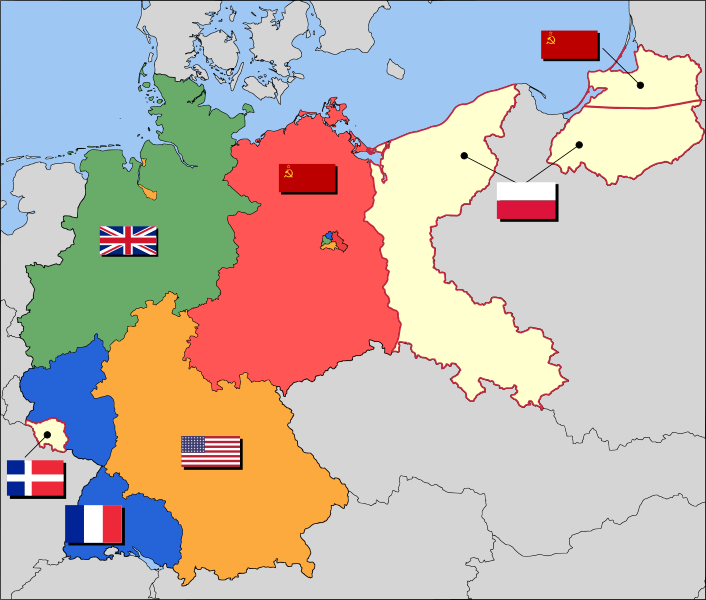 (Thanks Wikipedia! http://en.wikipedia.org/wiki/File:Map-Germany-1945.svg)
According to the official agreements drawn up in 1945, the three Western Allies were guaranteed full air access to West Berlin, and there was an informal agreement that they could use road and rail access routes as well.
But it was only a matter of time before tension began brewing between the capitalist Western Allies and the Soviet Union. And as a tiny, vulnerable outpost of Western ideology in the increasingly repressive and paranoid East German territory, the Soviets began using access to West Berlin as a bargaining chip in their wranglings with the western Allies. The Soviet leader Khrushchev privately referred to West Berlin as “the testicles of the West”. When he wanted to apply political pressure, all he had to do was squeeze.
Eventually, relations broke down completely. After the fiasco of the
Berlin Blockade, West and East Germany declared themselves as separate countries – the FDR and the GDR (or DDR in Deutsch). But as the East German economy became increasingly dysfunctional, and Western media broadcasts showed East Germans the post-war prosperity and democratic freedoms that
Wessis were enjoying, people started emigrating en masse to the West. In response, the DDR government closed off the entire border with West Germany – except through Berlin. After all, you can’t just run a wall through the middle of a city that’s been functioning as a single organism for 800 years… right?
Well, you can, apparently. Despite propaganda from the communist SED party referring to the emigrés as victims of capitalist
Kopfjagd (head-hunting) – implying that they had been bribed or kidnapped west as opposed to leaving voluntary – the DDR was still bleeding people through the loophole of Berlin. And it was losing just the wrong kind of people – doctors, teachers, engineers – the young, educated and ambitious. So, in 1961, the government decided to plug the leak.
Under cover of darkness on an otherwise quiet summer night, thousands of East German army personnel sealed off the entire 150km border around West Berlin. Berliners woke up to find that their brothers, sisters, children, parents, friends, sweethearts, colleagues – who yesterday may have lived a block away – were suddenly on the other side of an impenetrable barbed wire barrier watched over by an armed military guard.
Some situations created by the wall were truly bizarre. On one street called Bernauer Strasse, the apartment blocks on one side of the street were in East Berlin, while the street itself and the buildings opposite were in West Berlin. Residents of those buildings started trying to jump out the windows onto the waiting landing pads set up in the street by West Berliners. One guy was grabbed by the ankle by a DDR soldier on his way out the window, starting a human tug-of-war that eventually was won by the rescuers, who had gravity on their side. Eventually, only proven SED loyalists were allowed to live anywhere near the border on the eastern side.
Eventually, the barbed wire fence became a wall, and the wall became a metres-thick reinforced concrete barrier, to prevent cars from driving through it. The DDR installed sand traps, barbed wire, searchlights, and hundreds of watchtowers manned by soldiers carrying AK-47s. They were ordered to shoot anyone attempting to escape.
The bleeding had been stanched. East Germans were now safe from the bribery and kidnapping schemes of the West. During the 38 years of the wall’s existence, only around 5000 people successfully escaped to West Berlin, compared with the two million who had fled in the 50’s alone. But as a dude way more eloquent than me put it:
Beneath the facade of self-congratulation… the SED state was as insecure and paranoid as ever. It was not enough that the GDR’s citizens were quiescent. They had to love the party and everything it did.
- Frederick Taylor in The Berlin Wall (awesome, awesome book)
The infamous East German security service, the Stasi, had its beady eye on everyone. There was one Stasi employee or informant for every 66 citizens of the DDR. It could be your sister, your colleague, your best friend. They kept thick dossiers on every citizen. A colleague of mine told me a story about his father-in-law who grew up in East Germany. He needed to make an overseas visit for work, so he had to go to a government office to apply for his visa. At his interview, he sat in front of a desk with a row of files about three metres long, all containing information about him. He was only 24 years old. CREEPY.
If you voiced dissent openly, or were unfortunate enough to trust a poker-faced informant with your unpalatable opinions, the Stasi was known to follow a person down the street in a non-descript van, bundle them up off the footpath and cart them off to a gulag, often never to be seen again. Some of the interrogation camps were set up on former Nazi concentration camp sites. How
Animal Farm can you get??!!
In Berlin, I talked to a man whose family had fled through the Berlin escape hatch when he was a child in 1960. If they’d left it another year, they would have been trapped behind the wall. The most poignant thing he told me was that his mum and dad couldn’t even tell their own parents that they were leaving forever. They could be informants; and if they weren’t, the Stasi could come for them if they suspected they had known about the escape and not squealed. So they told them they were going to West Berlin for the evening for a birthday party, and never came back. By the time this man returned to Berlin after reunification, his grandparents had long passed away.
Of course, life wasn’t all bad in the DDR. If you weren’t on the government’s radar, you could have a pretty good life. You might not have had the latest and greatest “stuff” (there was a 12-year waiting list to get a car, for example), but you had job security, everyone earned about the same, and social services like child care were completely free. East Germans talk about the great sense of community that was fostered by the government-sponsored camps and clubs. Relationships with neighbours and friends become stronger when things aren’t always on hand at the grocery store and you need to ask around. And things were cheap. When we were in the DDR Museum, An East German guy approached us, protesting that from his memory, the Soviet-branded liquor bottle we were looking at was actually waayyy cheaper than it said on the label.
Still, people generally lived in fear of their own government. Many felt compelled to join the SED so their children wouldn’t be disadvantaged, or to deflect the penetrating gaze of the Stasi.
Over the years, a divided Germany became an accepted fact for people on both sides. My friend Guido, who grew up in West Germany and was a teenager when the wall came down, told me how his family would sometimes just drive out to the countryside to look at the border fence. As a child, he didn’t even know what was on the other side, or if there was even anything on the other side. In his mind, the wall was the end of the world.
A few times, his family went on weekend trips to visit West Berlin. Specially-designated road and rail routes still allowed FDR access to the western sectors. Guido described the road as a “highway with no exits”. You could see some quaint East German towns and villages as you drove along, but of course there was no question of stopping along the way. Once you were on the road, your safe passage was at the pleasure of the DDR soldiers on duty. Each time Guido’s family made this trip, he was instructed not to freak out if a soldier stopped them and left the children waiting in the car for three hours while interrogating the parents. It never actually happened, but it was a common enough occurrence that his parents felt the need to warn him about it.
So when the Soviet Union started to crumble under financial and political pressure in the late 80’s, and the wall came tumbling down, it was a truly monumental event in so many ways. On a personal level, it meant the achievement of long-awaited political and economic freedoms, and reunions with friends and family. On a national level, it meant the reunification of a people that had been artificially divided for almost half a century. And on a geopolitical level, it signified the end of a Cold War that had, at times, come to the brink of going nuclear.
I found this footage on Youtube of that fateful night – November 9th, 1989. It sent shivers up my spine. Do watch the whole thing if you have the time (it’s in German with English subtitles). If you only have time for one, watch Part 2.
Part 1 – first borders crossings at Bornholmer Brücke
Part 2 – confrontation at the Brandenburg Gate – embedded below
Part 3 – Who should be held responsible for the deaths of the hundreds of escapees who were shot trying to cross the wall?
Despite the euphoria of the initial border crossings, the move to a western-capitalist system hasn’t lived up to all the fervent hopes of East Germans. After many years of stability and guaranteed employment, acclimatising to the rough-and-tumble of the global marketplace has been difficult, especially for the older generation. The sudden freedom to travel sparked yet another post-wall brain drain to the west. A lot of East Germans never learnt English at school (they had to learn Russian as their second language), and as a result many international companies continue to set up shop in the west instead of the east. Despite government programs and investment, twenty years later there’s still a huge socio-economic gap between the east and the west. Unemployment is twice as high and per capita GDP is a third lower.
And in the rush to standardise after reunification, many of the cultural touchpoints that East Germans grew up with have been lost – the familiar supermarket brands, the cartoon characters they loved as children, the puttering two-stroke engine Trabi cars. The dapper, top hat-wearing
Ampelmännchen (traffic light guy) was only saved from EU standardisation by a grassroots protest movement.

As a result, there is a noticeable yearning for the past. At the flea markets in Berlin, you can buy DDR souvenirs such as army coats, uniform buttons and hats. I visited a store dedicated to selling Ampelmann-themed paraphernalia like t-shirts, keyrings and even Ampelmann-shaped pasta. You can even have East German-branded grocery items delivered to your doorstep from sites like
Ossiladen. These things are popular not just among people who grew up in East Germany, but among West Germans too.
Ossi is in.
This phenomenon of
Ostalgie, as it’s called in German (portmanteau of Ost=East and Nostalgie=Nostalgia), has been harshly criticised in some quarters as a whitewashing of the brutality and oppression many people experienced at the hands of the SED. But it’s understandable, I think. I don’t think there are many East Germans who deny that the communist regime was ruthlessly undemocratic. It’s more that the feeling that your culture is being erased makes you cling to it all the more. And it’s natural to remember mostly the good things about the past. I know now that the Enid Blyton books I read as a child were subliminally xenophobic and pretty blatantly sexist, but that doesn’t stop me from remembering them fondly.
One of the interesting places I visited while I was in Berlin was the DDR Museum. It’s jammed with old East German artefacts like school textbooks, propaganda posters, youth brigade uniforms, even an entire communist-era apartment with original furniture and appliances – including the bathroom! While it mostly feels nostalgic, there are some sinister little touches – like the fact that in a section of the museum that displays old Stasi surveillance equipment, you can eavesdrop on the conversations of the visitors in the living room of the reconstructed apartment.
One of my favourite bits was flipping through an old children’s song book. A crazy proportion of the songs were about soldiers and protecting the state.

Here is my terribly rudimentary translation of verse 2 – dear readers, please feel free to correct my mistakes :)
The tank is so heavy
How thick are its walls
Yet it hunts in the country
So swiftly and easily
It’s kind of funny/creepy to imagine children singing this!
As you can tell by the length of this post, this whole topic fascinated me no end. Here are some interesting links if you want to learn more.
My next post will be about the 20th anniversary celebrations – stay tuned :)