I guess it’s similar to my complete lack of appreciation of sunny days growing up in Sydney. It was only when I moved away that any glimpse of blue sky made me want to throw a party.
So in the lead-up to my visit to Barcelona, I wasn’t too wound up by all the rave reviews I’d heard of its most famous landmark, La Sagrada Familia. After all, it’s just another European church to check off the list. My prediction: It would be beautiful, fo’ sho’, but probably nothing particular unique. Right?
Omg.
The church of La Sagrada Familia is nothing less than the most exquisitely designed building I have ever visited. It was designed by the legendary Catalonian architect Antoni Gaudi, whose unique creations are studded like jewels all over the city of Barcelona. La Sagrada Familia was his magnum opus – only one-third finished when he died, and still a work in progress to this day, over 120 years after the first stone was laid. This is a building for the ages.
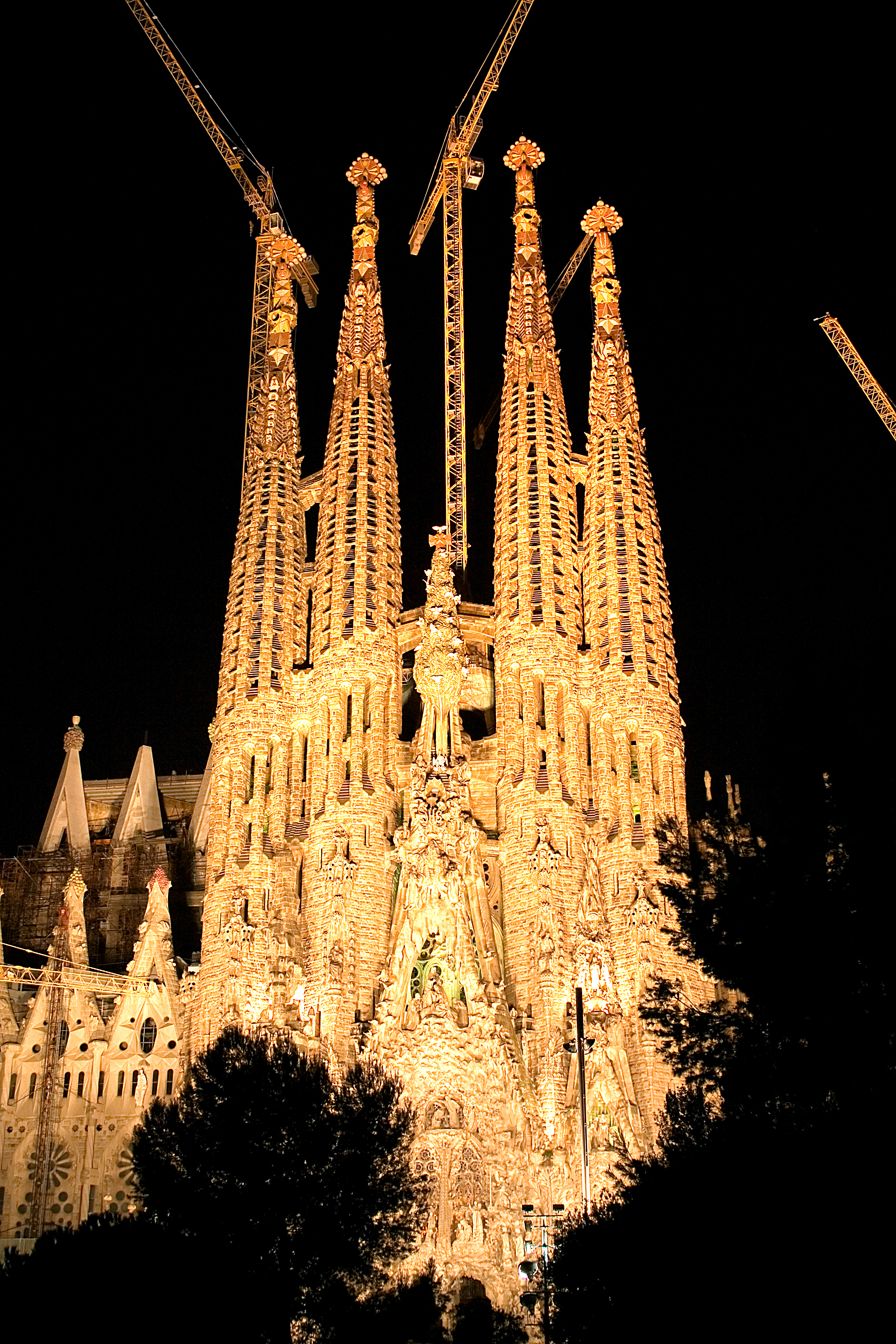
(Picture from Wikimedia Commons – mine did not come out so good.)
It really is hard to know where to start describing this thing. Basically Gaudi took all the things that make the old European churches so impressive and gave them a modern twist. For example, he wanted to capture the grand feeling that a lofty ceiling lends, but didn’t want traditional weight-bearing arches blocking the sightlines inside the church.
So he carefully studied the structural properties of trees, and instead of hefty arches, he installed gorgeous white, slender, tree-like columns at regular intervals. The twisting shapes of the columns and the branches that sprout from atop each one are modelled on geometric forms in nature. The roof itself is studded with giant golden flowers. The effect is of walking through a tall, silent forest.

Then there are the two completed facades at the front and back of the church (as I mentioned, it’s still under construction). The Nativity facade is the more traditional-looking one. It’s meant to represent the hope brought to the world by the Nativity – I thought of it as the Happy Facade. The intricacy of it is just mind-blowing.
Every inch is so detailed that I had to pause my audio guide about twenty times to pick out each mentioned detail from the visual torrent of stone animals, plants and people. And I think I still missed about half of them. Again, my photos don’t even do 20% justice to this place.

On the other side of the church is the Sad Facade (ok, it’s actually called the Passion facade). It was created some decades later by a different artist, although still in the spirit of Gaudi’s original design. It definitely looks more modern, yet still exudes tradition. And it’s very sparse in contrast to the riotous exuberance of the Nativity Facade, but no less dramatic for it.

Here’s a cool fact that appealed to my nerdy side (that’s all my sides, to be exact). Gaudi made these upside-down models to figure out exactly how the parabolic curves of his buildings’ towers should be constructed. He would weigh down each part of the “roof” with little bags of sand that were proportional to how much weight would be borne by that part of the roof once the building was up. Awesome, non?

There is so much more I could say about this place, but there’s no point. It has to be seen to be believed. I am not a church person. And I loved it. I’d heard the hype, and I’d heard the meta-hype (ie. people saying “it lives up to the hype!”), and was not disappointed. (Hereafter, anyone who reads this entry and then goes to Barcelona will be testing whether it lives up to meta-meta-hype. Whoa.)
Once you’ve seen La Sagrada Familia, you enter a trance-like state where all you want to do is walk around Barcelona looking for more examples of Gaudi’s genius. And there is plenty more where that came from. Barcelona is like a living textbook of the quirky, whimsical Modernist movement in architecture, whose buildings make you feel like you stepped through the looking glass.

Although the church is definitely the most epic and impressive of Gaudi’s contributions to Barcelona, I think my personal favourite was Park Güell, a big garden in the hills north of the city. It’s already blessed with an amazing location, offering panoramic views of the city from all sides. It was a beautiful sunny autumn day when we visited, and the park was full of people and music.

On this bright canvas Gaudi added his magic, with cool spots to sit and chill out, like this Jurassic-looking bridge lined with benches…

… colourful balconies overlooking the city…

… and some generally crazy-looking stuff that makes you wonder whether there was something not quite kosher about that pitcher of sangria you ordered at lunch. Whatever that Gaudi guy was smoking, I want some.


No comments:
Post a Comment